The Global Risks Report 2025, published by the World Economic Forum (WEF), provides a thorough analysis of the biggest challenges the world faces now and over the next ten years. This report, which builds on the annual Global Risks Perception Survey (GRPS), offers deep insight into trends, risks and strategies for addressing global challenges.
It was compiled by the World Economic Forum in collaboration with Marsh McLennan and Zurich Insurance Group. The findings are based on contributions from more than 900 experts from diverse sectors. In addition, insights were gathered via the Executive Opinion Survey and contributions from risk specialists and thematic experts. The methodology combines both quantitative and qualitative analysis.
The Global Risks Report aims to inform policymakers, business leaders, academics and other stakeholders about global risks and trends. It focuses on promoting international cooperation and preparing societies for complex challenges. The target audience consists of public and private leaders, academics and civil society organisations seeking solutions to global risks.
Key messages
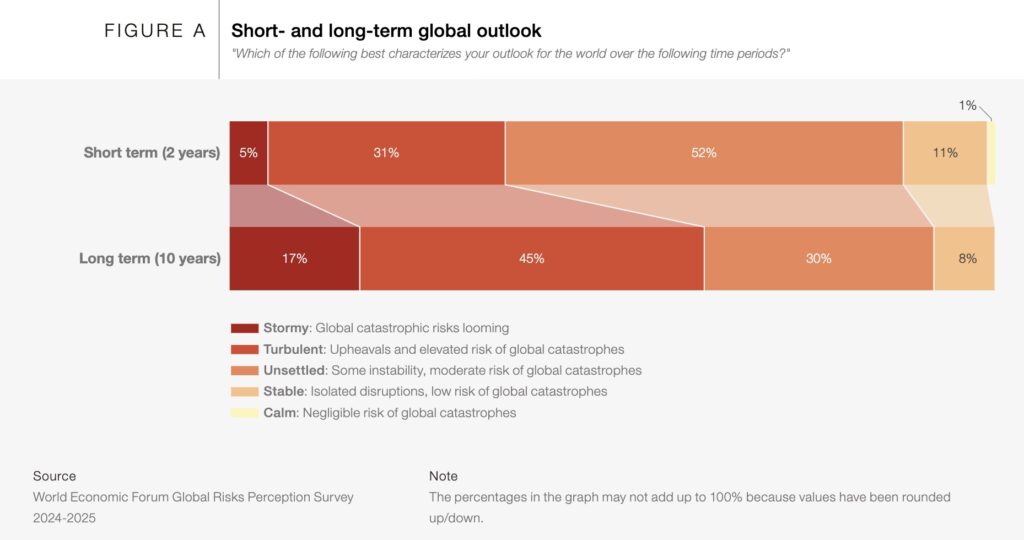
The overall tone of the report is grim, with the term “bleak” summarising the current and future situation. It emphasises the urgent need for multilateral solutions to address global risks, ranging from geopolitical tensions to climate change and technological risks. The outlook for both the short and long term has become more pessimistic. In this edition, 62% of respondents believe the world faces turbulent or even catastrophic times over the next ten years, an increase of 4 percentage points compared to the previous year. State-based conflicts, considered less significant in earlier editions, have now emerged as the most pressing risk. This reflects the deterioration of international relations and the escalating number of conflicts. Whereas in earlier editions climate risks such as extreme weather were already emphasised, the impact of this is now seen as more urgent, especially due to record temperatures in 2024 and the increasing frequency of natural disasters.
- Geopolitical risks dominate the short term
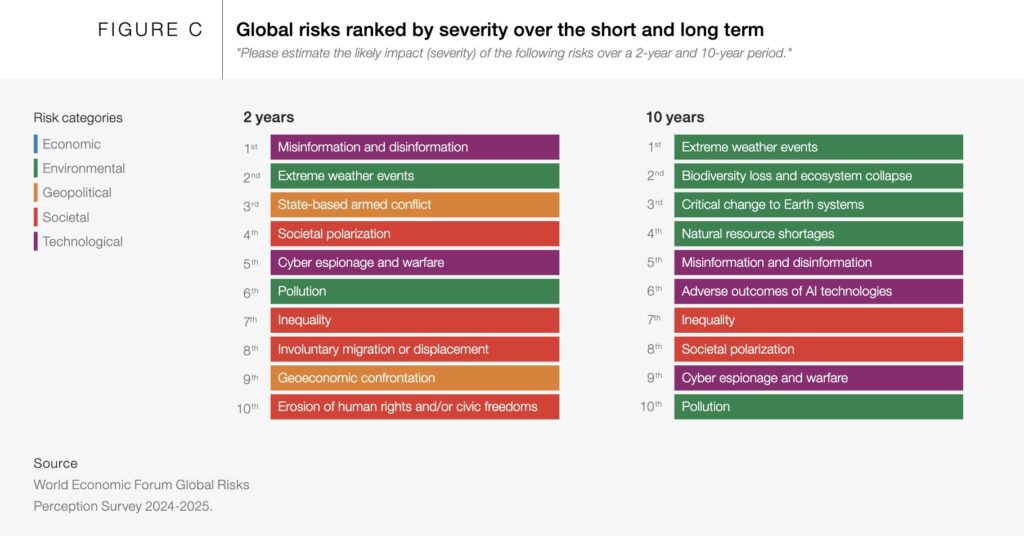
- State-based armed conflict ranks first as the most acute risk in 2025 for the first time. This reflects the impact of conflicts such as the war in Ukraine, tensions in the Middle East, and internal conflicts in countries such as Sudan.
- Geo-economic confrontation, such as sanctions and trade wars, is also increasing in importance and ranks third in the short term.
- Environmental risks continue to dominate the long term
- Extreme weather events, such as heatwaves, floods and wildfires, remain among the greatest risks in both the short and long term.
- Biodiversity loss and ecosystem collapse takes a prominent place in the long term (ten years), and the severity of these risks continues to increase.
- Technology and misinformation
- Misinformation and disinformation remains the dominant risk in the medium term (2027), amplified by the rise of generative AI and other technologies that make it easier to spread false information.
- Cyber espionage and cyber warfare are a growing concern in the short term, with increasing threats from state actors and sophisticated cyberattacks.
- Demographics and social fragmentation
- Super-ageing in countries such as Japan, South Korea and Germany is creating structural challenges, including labour market shortages and a crisis in pension systems.
- Social risks, such as inequality and societal polarisation, continue to score highly, with major concerns about the consequences of economic inequality and social division.


All global risks
The Global Risks Report 2025 identifies a wide range of risks that could have a significant impact on the world in the coming years. Below is an overview of the main risks, organised by category:
Economic risks
- Economic downturn (recession, stagnation)
- Inflation
- Debt
- Shortage of economic opportunity or jobs
- Asset bubble burst
- Concentration of strategic resources and technologies
- Criminal and illegal economic activity
- Labour and talent shortages
Environmental risks
- Extreme weather events
- Critical change to Earth systems
- Biodiversity loss and ecosystem collapse
- Pollution
- Natural resource shortages
- Non-weather-related natural disasters
Geopolitical risks
- State-based armed conflict
- Geo-economic confrontation (sanctions, tariffs, investment screening)
- Cyber espionage and warfare
- Biological, chemical, or nuclear weapons or threats
- Intrastate violence (civil wars, insurgencies)
Societal risks
- Societal polarisation
- Inequality (income, wealth)
- Involuntary migration or displacement
- Erosion of human rights and/or civil liberties
- Inadequate public infrastructure and social protection
- Decline in health and wellbeing
Technological risks
- Adverse outcomes of AI technologies
- Adverse outcomes of frontier technologies
- Censorship and surveillance
- Online harms (abuse, cyberbullying)
- Critical infrastructure disruption
- Critical supply chain disruption
Other risks
- Infectious diseases
- Non-weather-related natural disasters (e.g. earthquakes)
The world in 2035
The report offers a vision of a world in 2035 in which multiple structural forces, such as demographic change, climate change, technological developments and geopolitical shifts, continue to shape the global stage. These forces reinforce one another and lead to an increased level of complexity and uncertainty. The vision of 2035 in the Global Risks Report 2025 is not a specific scenario as you would see in a scenario planning process, but rather a projection based on current trends and structural forces that persist without significant intervention. The picture of 2035 functions as a warning and highlights what could happen if global cooperation and intervention fail to materialise. It is not a detailed scenario with specific storylines, but a broad sketch of the risks and tensions expected to keep growing.
Key elements of the outlook:
- Environment and climate:
- The impact of climate change has increased considerably, with a deterioration of biodiversity and an escalation of extreme weather events. The world stands at a crossroads where decisions on environmental and energy policy are crucial to prevent further damage.
- Technological risks:
- Technological innovations, particularly in AI and biotechnology, have brought progress but also created new risks, such as ethical dilemmas, uncontrolled developments and possible misuse of technologies such as gene editing.
- Demographics:
- Super-ageing has become a critical issue, with countries such as Japan, South Korea and Germany facing acute labour market shortages and crises in pension systems and long-term care.
- Society and social cohesion:
- Inequality and societal polarisation remain prominent problems. There is increasing fragmentation within societies, which hampers the ability to respond jointly to global challenges.
- Geopolitical relations:
- A multipolar world order has consolidated further, characterised by competing major powers and a lack of effective cooperation at the global level. Regional power blocs set the tone, and international cooperation is under pressure.
Presentation/publication
The full report can be downloaded from the website of the World Economic Forum. In addition to the full report, the website offers various supplementary resources and tools to explore the findings and insights. These include:
- Summary of key findings: The report’s core points are highlighted briefly and concisely to give a quick overview of the trends and risks.
- Interactive data platform: Users can analyse the risks and trends via interactive charts and dashboards, sorted by categories such as time horizon, severity and geographic impact.
- Infographics: Visual representations of complex data to make trends and connections clear.
- Presentation video: A video in which experts from the World Economic Forum explain and discuss the key risks.
- Podcast: An in-depth discussion of the role of geopolitical instability, technological disruption and environmental problems in current and future risks.
Read here about the previous editions of the WEF Global Risks Report:


