Source: WRR exploratory study (28 September 2026) De toekomst in beleid – Zoeken naar zekerheden voor 2050 (The future in policy: searching for certainties for 2050). This is an exploratory study, not an advisory report: according to the WRR, its contents do not necessarily reflect the Council’s position.
The main argument
Calls for clear choices about the Netherlands’ future are growing louder: what kind of country do we want to be in 2050? See for example the publication Kiezen voor Later (CPB) from 2024. The WRR reframes that question: what kind of country can the Netherlands be in 2050? It argues that this question is at least as important. According to the Council, futures studies often focus on uncertainties, for example through scenarios and tipping points, and therefore do not always offer much guidance. The study therefore takes certainties as its starting point. The aim is not to predict the future, but to bring long-term developments into policy discussions from the outset. With this approach the WRR wants to broaden the toolkit of futures research.
The exploration grew out of conversations in early 2025 with the Secretaries-General Consultation (SGO), which asked which future certainties should influence today’s choices. The advisory process started on 28 October 2025. The exploration was published on 28 September 2026 and will be presented on 13 October to the Prime Minister and the State Secretary for Kingdom Relations and Efficient Government.
Method: how did the exploration come about?
Rather than presenting scenarios or forecasts, the study develops an analytical framework and a practical tool for applying it. The time horizon is 2050 (25 years ahead), explicitly “to illustrate the instrument to be developed”. The authors stress that certainties for 2050 are not necessarily certain for 2100. The analysis covers the European part of the Kingdom; according to the authors, the approach could also be adapted for use in the Caribbean part of the Kingdom.
- Conversations: the project group spoke with more than fifty scientists, policymakers, administrators and other experts. Interim insights were shared with the SGO in November 2025 and April 2026.
- Literature and trend studies: the four major shifts were chosen because they recur often in trend studies. According to the authors, the classification partly resembles the DESTEP analysis (with geopolitics instead of politics) and megatrend studies. For each shift they describe the historical roots, the cross-links with other shifts and an outlook to 2050, meant to stimulate thinking about the future rather than to predict it.
- Imagination through literature: the authors drew inspiration from Dutch-language novels. Each section in the chapter on the major shifts contains a literary interlude to stretch the imagination, for example Bordewijk’s Blokken (1931) on technology as dystopia and Eva Meijer’s Zee Nu (2022) on sea level rise. This is an example of a way of working related to science fiction prototyping and design fiction: fiction makes possible futures easier to imagine and discuss, including for readers who find data and scenarios less engaging.
- Positioning: the instrument is explicitly a complement to projections, scenario studies and future visions, not a replacement. The authors refer, among others, to the threefold distinction of forecasting, foresight and normative studies by Van Asselt et al. (2010).
Three kinds of certainties for 2050
The framework distinguishes three kinds of certainties that should influence today’s choices:
- Major shifts (certainties of change): developments in knowledge and technology, climate, demographics and geopolitics. The direction is fixed, but according to the authors pace, scale and outcome sometimes remain uncertain for a long time, until a tipping point is reached.
- Anchor points (certainties in what is and will be): givens that are as good as fixed until 2050 and that define the space within which policy can develop.
- Tensions (the certainty of societal challenges): these arise from collisions between major shifts and anchor points, for example as vulnerabilities, value conflicts or necessary choices.
The four major shifts
- Knowledge and technology: technological innovations in AI, robotics and biotechnology change life profoundly towards 2050. The exploration notes a convergence of AI, bio-, nano- and neurotechnology and describes four societal dynamics: hubris, the distribution of burdens and benefits, social cohesion and voice.
- Climate: the earth is warming and the Dutch climate is changing. Human influence is dominant, tipping points and partly irreversible processes play a role, and the text distinguishes between mitigation and adaptation.
- Demography: the Dutch population is ageing and fewer children are being born. Migration largely determines population growth. According to the authors, births and deaths are relatively predictable, while migration is more erratic.
- Geopolitics: centres of power are shifting and the world order is fragmenting through more diverse forms of exercising power and diverging worldviews.
Anchor points at three levels
The anchor points are divided into macro, meso and micro levels, supplemented by space. The authors themselves indicate that this selection “could also have turned out differently”. The WRR infographic names the following anchor points:
- Interwoven world: a smaller working population beyond our borders, economic interdependence with other countries, digitalisation everywhere and limits to the stability of the planet.
- Country and society: a small, low-lying, engineered river delta, the fixity of the built environment and infrastructure, the long shadow of education and training, and deep traces of history.
- Human beings: a Pleistocene brain, (intergenerational) survival drive, humans as social beings and the need for meaning.
- Limited orbital space around Earth.
The TiB step-by-step-by-step plan: getting tensions on the table early
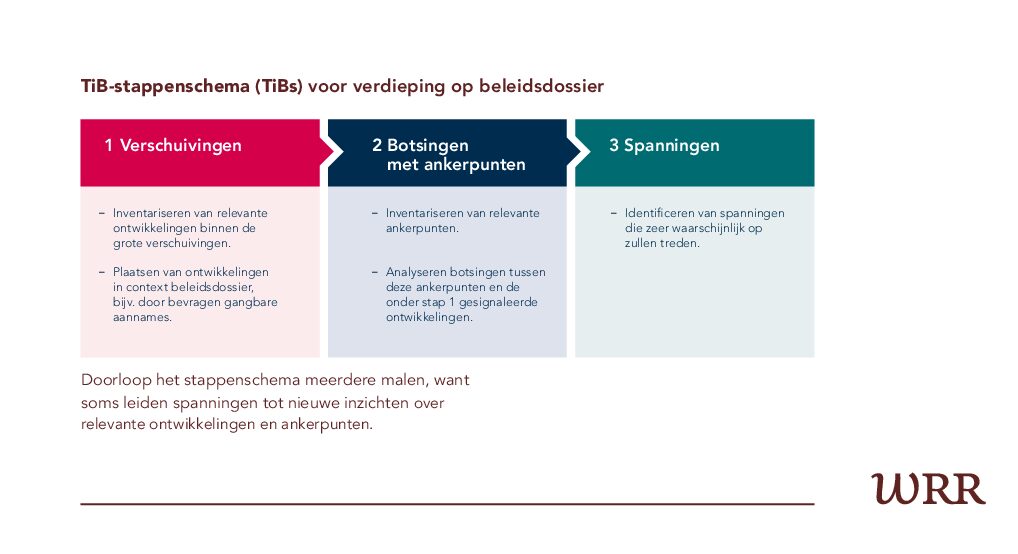
Based on the threefold distinction, the WRR developed the Future-in-Policy step-by-step plan (TiBs, from “Toekomst in Beleid”), together with a collision matrix (available as a separate annex to download with the exploration). The scheme runs through three steps for a concrete policy issue:
- Shifts: take stock of the relevant developments and place them in the context of the policy issue, for example by questioning common assumptions.
- Collisions with anchor points: take stock of the relevant anchor points and analyse collisions with the developments from step 1.
- Tensions: identify the tensions that are very likely to occur.
The exploration gives practical tips for each step. Go through all shifts and discuss context and assumptions with each other, and stretch the imagination by involving artists or writers. Do not dismiss an anchor point too quickly as irrelevant and include all levels. For tensions, think about the different forms (choices, vulnerabilities and opportunities, value conflicts) and formulate the questions that come up. Also go through the scheme several times, because tensions sometimes lead to new insights about relevant developments and anchor points.
What becomes visible: examples of tensions
By examining certainties systematically, new insights and questions emerge, according to the WRR. A few examples from the exploration and the accompanying publications:
- The pursuit of strategic autonomy turns out to be an ecological issue as well.
- Questions of meaning and purpose also matter when considering the future of work. The study applies the step-by-step plan to the future of the labour market.
- Climate adaptation collides with the skills profile of the workforce: more workers are needed than will be available, which puts the feasibility of adaptation plans under pressure.
- Creative destruction in business policy collides with preserving employment and community identity.
Dilemmas and caveats from the authors
- No predictions or clear-cut policy answers: the framework does not produce clear-cut policy answers. It identifies likely points of friction so that policymakers can discuss them more productively.
- Certainty depends on the time scale: what is certain until 2050 need not be certain until 2100, and the selection of anchor points is not “the” list.
- Disruptions remain possible: a disaster or nuclear war cannot be ruled out, but according to the authors it is still worthwhile to also look at the certainties in case such events do not occur.
- Tension with future cancellation: the authors are concerned about the lack of future-oriented action. According to the WRR, the Netherlands is getting stuck on several files, such as the nitrogen crisis, the housing shortage and the filling-up electricity grid (grid congestion). In the recent past, perhaps too little attention was paid to tomorrow’s concerns. As an example the exploration mentions the Ministry of Housing, which was abolished fifteen years ago, while there is now a large housing shortage. The Netherlands turned out to be less “finished” than thought at the time (p. 15).
In a footnote the WRR refers to the concept of future cancellation from the academic literature (De Rijk & Feitsma, 2025): the ability to imagine a different future may have declined. The concept stands for the concern that the future is explored less in policy than necessary. It fits the design of the exploration to make the long term discussable early. The link with the literary interludes, which are meant to stretch the imagination, is an interpretation by the editors.
Who is this exploration for? A different audience, a different contribution
The WRR develops the instrument primarily for policymakers. The step-by-step plan is meant to start a meaningful conversation between ministers, policymakers and strategists (p. 90). The exploration is therefore not a methodological handbook for professional futurists. This helps explain why much of the approach will be familiar to professional futurists. Ideas that are familiar to futurists can still help policymakers engage with long-term issues. The contribution may therefore lie less in developing a new method than in organising existing knowledge and making it usable in policy practice.
The following sections present the database editors’ interpretation, not the WRR’s. We consider both what the framework adds methodologically and how it can be used alongside existing foresight methods.
Certainties and foresight practice: a complementary interpretation
Including relatively certain developments has long been common in foresight practice. In the step from trend analysis to scenario planning, developments are usually weighed on impact and uncertainty, and the relatively certain developments form the common foundation of scenarios (also called “predetermined elements” in the scenario literature).
The handbook Grip op de toekomst (Silke den Hartog – de Wilde, 2017; chapter 4, Trend analysis, p. 36) shows how this combination determines what you do with a trend:
- High impact, high uncertainty: the core of the exploration and the basis for scenarios.
- High impact, low uncertainty: trends an organisation will face in any case. These must be addressed in the strategy and that is not optional.
- Low impact, low uncertainty: can be left out of consideration or belong to another issue.
- Low impact, high uncertainty: belong on the R&D agenda, because more research is needed before you know whether you want to do something with them.
On p. 55 the same handbook extends this logic to scenario planning: trends with high impact and low uncertainty must return in every scenario, with one or two variants. Scenario planning is therefore not opposed to working with certainties, but explores how relatively certain and uncertain developments together shape possible futures.
The WRR itself presents its instrument as a complement to existing methods (see “Positioning” above) and refers to Cynthia Selin (2025) for an alternative typology of certainties. According to the authors, forecasts and scenario studies remain valuable, and the step-by-step plan mainly places more emphasis on trade-offs (p. 101).
What the WRR approach specifically adds
The approach adds value by organising shifts, anchor points and tensions into a structured policy discussion. Anchor points are not all trends: a low-lying river delta, long-lasting infrastructure and the human need for meaning are enduring conditions that shape how change affects society. Examining how major shifts interact with these enduring conditions can reveal policy questions that a list of trends alone might miss.
The authors acknowledge that policymakers and scientists probably already know the content of most cells in the collision matrix. According to them the value lies in the whole, in the comprehensiveness of the issues and in the conversation between ministries (p. 100). They deliberately carried out the cases as a quick analysis, meant to be done in half a day. That makes the step-by-step plan interesting as an accessible first assessment and a way to set the agenda. A quick scan shows that the approach generates questions. It does not yet show that the outcomes are certain or that the approach performs better than existing alternatives. An explicit comparison with existing ways of working on the same file is missing, and that could further support the claim that the toolkit is being broadened.
Different kinds of certainty call for different tests
The framework groups together several kinds of certainty. They differ in the evidence supporting them and in how much policy can influence them: physical givens (the location of the Netherlands, planetary boundaries), slowly changing structures (the built environment, the “long shadow of education and training”), human constants (the need for meaning, social needs), the directional certainty of shifts (whose precise outcome remains uncertain) and derived tensions, which are an inference and not a given. The WRR itself acknowledges that certainty depends on the time horizon and that anchor points can ultimately change.
For anchor points the WRR uses three criteria (p. 68). It must concern a given or development whose state in 2050 is known, relevant for today’s policy choices and relevant for multiple policy areas. Policy cannot (any longer) influence that state in 2050. For the location of the Netherlands this is understandable. For anchor points such as “digitalisation everywhere” or “long shadow of education and training”, the level of abstraction does a lot of the work. Broad statements can appear highly certain. Once translated into specific policy questions, however, both uncertainty and scope for policy action become more visible.
The step from collision to tension also deserves an extra test. For tensions the WRR speaks of “almost certain”, for example that climate adaptation in combination with the educational profile of the workforce will lead to staffing problems in 2050 (p. 20). That is an understandable policy warning. However, certain starting conditions do not guarantee a certain outcome. The causal links between them also need to be supported by evidence. Scenarios can help explore when a tension might intensify, weaken or take a different form.
A practical addition is to make explicit for each important statement:
- which element is considered relatively certain;
- what that judgement is based on;
- which elements remain uncertain;
- what policy can still influence;
- under which circumstances the assumption must be revisited.
A connection, not an opposition
The exploration states that a look at certainties gives insight into options for action and trade-offs, alongside the risks and opportunities that a focus on uncertainties makes visible (p. 11). The WRR case on unexpected climate events shows at the same time that uncertainty also calls for action. On the possible collapse of the AMOC, the authors write that starting to prepare only at a high degree of certainty probably leaves too little time for adjustments in the built environment. Relatively certain developments therefore call for anticipation, and critical uncertainties for robust choices, flexibility, targeted preparation and keeping options open.
The TiB step-by-step plan can therefore be used alongside scenario analysis to examine policy impacts and dilemmas (this is the editors’ interpretation). First it maps shifts, preconditions and tensions. Then scenarios can explore how those tensions play out under different circumstances, after which strategic options are tested. In an impact and uncertainty framework, the scheme mainly elaborates the “high impact, low uncertainty” quadrant. Scenarios explore the “high impact, high uncertainty” quadrant.
When do you use the WRR framework, and which methods do you combine it with?
This too is an interpretation by the editors and not a statement by the WRR. The step-by-step plan seems most useful when there is a clear policy question and the scope of the analysis has already been defined. The question is then what is already relatively fixed, which tensions follow from that and where policy can still have influence. It also works with limited time. As the only method it is less suitable when the core of the challenge is deep uncertainty, for example with widely diverging developments that influence each other, when there is no policy question yet, or when the aim is to challenge assumptions and mental models.
Possible combinations with other methods:
- Before applying the framework: horizon scanning, signals analysis or trend analysis to find candidate anchor points and uncertainties, distinguishing by certainty and impact.
- Alongside the framework: scenario analysis for the uncertain side, for example with critical uncertainties as axes, while the WRR scheme elaborates the relatively certain side.
- After identifying tensions: testing strategic options with stress tests or adaptation pathways when choices must be spread over time, or with backcasting when a vision of a desired future exists.
- When the framework may be sufficient on its own: for a small, delimited question with limited uncertainty the scheme can suffice without a full scenario process.
- When other methods fit better: for open explorations without a policy question, or for issues where values and perspectives clash, participatory scenario development or a perspectives method is more obvious.
How much time and how many people does it take? The WRR gives no fixed standard for this. The exploration does say the following:
- The project group deliberately carried out the cases in limited time. The aim was to make the analysis in half a day (p. 100). According to the authors this worked because the analyses of the major shifts and anchor points provide support.
- For the first step the WRR mentions discussions with external experts or a group brainstorm, and discussion with experts inside and outside one’s own ministry. To stretch the imagination it mentions artists, writers, designers, young people and possibly AI (pp. 88 and 89).
- The step-by-step plan is meant to be run through several times (p. 90). A serious application therefore takes more than one round.
Two caveats from the editors. First, the half-day estimate assumes that an overview of shifts and anchor points is already available. Producing that overview required substantial research, and in a different context or time horizon the anchor points must be reviewed again (the WRR itself notes this).
Second, the WRR does not compare the required effort with that of other methods. Based on general practical experience, and not on the WRR, the scheme seems lighter than a full scenario process. Whether the results are equally useful or reliable has not been investigated.
There is as yet no comparative research showing which combination works best. These are therefore working hypotheses that must be tested in practice.
Embedding in the organisation: a next step
The concluding chapter (chapter 5, pp. 103 to 107) deals with three conditions for future-oriented policy: political direction, legitimacy and the level at which policy is made. The WRR argues for a political culture in which futures explorations are not incidental activities but a fixed part of decision-making (p. 104), with well-equipped parliamentary groups, strong scientific bureaus and investment in strategic policy development. For the civil service side, the exploration refers to the earlier WRR report Deskundige overheid (report 113, 2025).
The WRR thus states the ambition explicitly. What remains less developed is how policy organisations put that ambition into practice: who monitors emerging signals, who owns and updates the analysis, how the findings feed into policy and budget cycles, and how organisational maturity is assessed. Early warning appears only in the reference list (an article on climate tipping points) and not as part of the approach. This is an understandable choice for a study focused on an analytical tool, but it also leaves scope to develop the organisational side further. The WRR news item speaks of identifying themes early. Here, early identification means raising policy tensions at the start of the discussion, not monitoring developments on an ongoing basis.
I elaborate that organisational side in a separate blog on toekomstverkennen.nl (in Dutch): how to get from a one-off exploration to a lasting practice, with a foresight maturity framework, a link to a signalling system and the OECD literature on embedding foresight in government.
Interesting observations for futurists / for the database
- Because the exploration presents no scenarios or future images, a comparison with Jim Dator’s archetypes or Mary Douglas’s grid-group quadrants is not relevant here. That is an observation in itself: the WRR deliberately positions itself alongside scenario thinking and not within it. How the instrument relates to scenario planning and other methods is worked out in the sections above.
- A reversal of the usual approach: where most futures studies in the database start from uncertainties (scenario axes, wild cards, tipping points), the WRR chooses certainties as its starting point. This fits the criticism of the temptation to embrace uncertainty as the only certainty, making everything “relative, provisional and conditional”.
- Imagination as a methodological component: using Dutch literature to stimulate the imagination is rare in policy explorations and fits the futuring approach in which breaking existing thought patterns is central.
- Blind spots to test: the anchor points were chosen by one project group and depend on the time scale. It is worth looking at how stable the list is when different groups draw it up.
Additional material on the WRR website
Besides the full report, the WRR has published a number of tools with which the framework can be used directly. This material is available in Dutch. With a step-by-step plan, a collision matrix and an infographic as a discussion poster, the WRR offers a working method for interdepartmental conversations and not just a future image, comparable to methodological sources such as the Perspectives Method.
- Infographic (PDF, 1 page): overview of the three kinds of certainties and how they interact. Online it is also available as a discussion poster, a visual representation of how major shifts collide with anchor points and lead to tensions.
- Step-by-step plan (PDF, 1 page): the TiB step-by-step plan with tips per step.
- Collision matrix (PDF, 1 page): the matrix in which major shifts are plotted against anchor points. This comes closest to the impact matrix you use in practice to see where the consequences are greatest.
- Summary (PDF, 7 pages).
- News item and the podcast Vogelvlucht #37, in which Corien Prins and Ramy El-Dardiry discuss the exploration, including the role of Dutch literature for the imagination.
I did not find an English-language version of the exploration or of these tools on the WRR website. The English-language WRR site (english.wrr.nl) does not mention this exploration at the time of writing.
This exploration connects to a long WRR line on futures work: Beleidsgerichte toekomstverkenning (1983), Vijfentwintig jaar later (2004) and Uit zicht: toekomstverkennen met beleid (2010). For the broader context see The tradition of futures exploration in the Netherlands and, for the geopolitical shift that the WRR also names as a certainty in this report, WRR (2024): The Netherlands in a fragmenting world order. The WRR itself also mentions “Toekomstgericht beleid. Perspectieven en agenda’s uit het werk van de WRR” (2024) as an earlier publication on this topic.
Source:
- Dutch-language publication: WRR, De toekomst in beleid: Zoeken naar zekerheden (28 September 2026)
- Project page: wrr.nl/adviesprojecten/de-toekomst-in-beleid
- Summary (PDF): Summary of the exploration
- Podcast Vogelvlucht #37: De toekomst in beleid: Zoeken naar zekerheden
- Supplementary (trend analysis): Silke den Hartog – de Wilde, Grip op de toekomst (Bureau Tijd & Ruimte, 2017), chapter 4, p. 36 and chapter 5, p. 55


